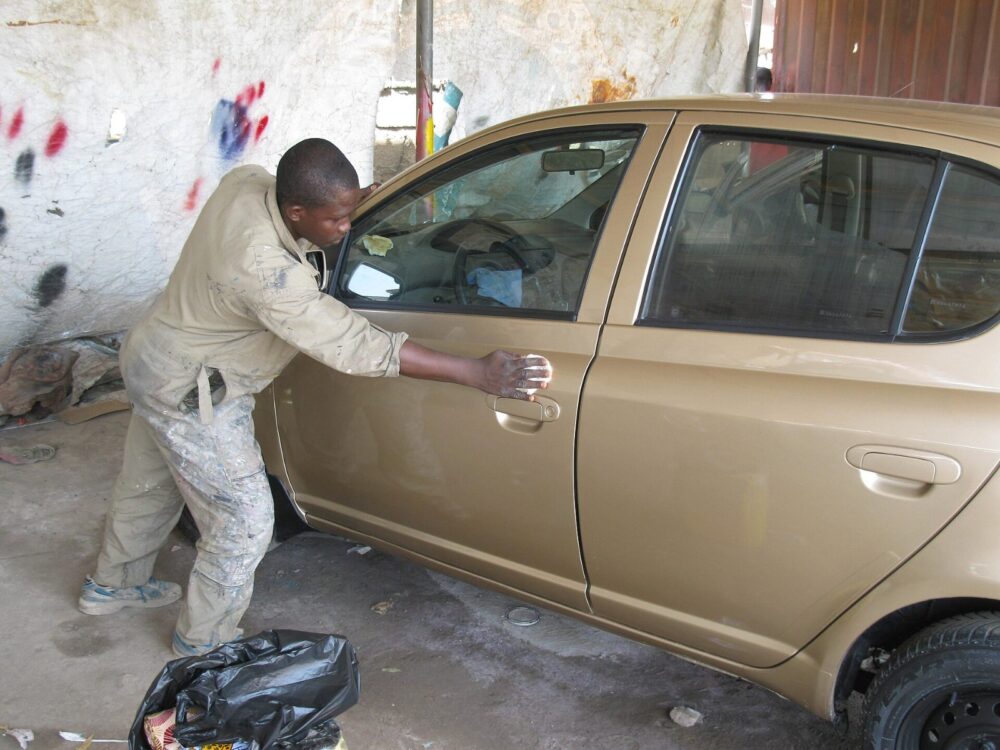
A car polishing service uses machine polishers and abrasive compounds to remove a very thin layer of clear coat, levelling out swirl marks, light scratches, water spots and dullness so the paint reflects light cleanly again. A good service starts with a thorough wash and decontamination, measures and inspects the paint, uses the least aggressive method that works, and finishes with protection so the result lasts in UAE sun and dust.
In this guide
Polishing, waxing and compounding: what is the difference?
The words are often used loosely, which makes quotes hard to compare.
| Term | What it does | Removes defects? |
|---|---|---|
| Compounding (cutting) | Uses a more abrasive product to remove deeper defects | Yes, heavier swirls and scratches |
| Polishing (finishing) | Uses a finer abrasive to refine the surface and boost gloss | Yes, light defects and haze |
| Glaze | Fills minor defects temporarily for shine | No, hides them for a while |
| Wax or sealant | Adds a protective layer and gloss | No |
| Ceramic coating | Hard, long-lasting protective layer | No |
A “one-step polish” uses a single product and pad combination to balance correction and gloss. A “two-step” or “multi-stage” correction uses a cutting stage followed by finishing, and takes much longer.
Why UAE cars need polishing
- Wash-induced swirls from brushes, dirty towels and dry-wiping dust
- Water spots etched by mineral-rich water drying in the sun
- Oxidation and fading, especially on older single-stage paints and dark colours
- Bird droppings and tree sap that etch the clear coat in heat
- Fine scratches from sand and daily use
Polishing addresses these by levelling the surface, but it cannot restore clear coat that is already peeling or failing.
Polishing removes a small amount of clear coat each time, so a good detailer polishes only as much as the paint needs.
What a quality polishing service includes
- Thorough wash of the whole car, including wheels and door shuts.
- Decontamination with iron remover and clay to remove bonded contaminants.
- Inspection under strong lighting to see the real condition of the paint.
- Paint thickness measurement with a gauge on each panel, to spot thin areas and previous repaints.
- Masking of rubber, plastic trim and badges to protect them from polish residue.
- Test section on one panel to choose the pad and product combination.
- Correction panel by panel, checking progress under lights.
- Wipe-down with a panel prep spray to reveal the true finish without oils.
- Protection with wax, sealant or coating.
Questions to ask a detailer
- Do you measure paint thickness before polishing?
- Is this a one-step or multi-step correction, and what level of defect removal should I expect?
- Which protection product is included and how long should it last?
- Will the work be done indoors or in shade?
- How long will you need the car?
How much correction is realistic?
Expect improvement, not perfection, on most daily drivers. Deeper scratches that catch a fingernail usually go through the clear coat and cannot be polished out safely. They may need touch-up paint or a body shop.
| Paint condition | Typical approach | Expected result |
|---|---|---|
| Light swirls, good gloss | One-step polish | Most swirls removed, strong gloss |
| Moderate swirls and haze | Two-step correction | Large improvement, minor marks may remain |
| Heavy scratches and oxidation | Multi-step with careful checks | Significant improvement, deeper marks remain |
| Thin or repainted panels | Light polish only | Limited correction to protect clear coat |
Protecting the result
Freshly polished paint has no protection left on it. Applying a wax, sealant or ceramic coating straight afterwards protects against UV, bird droppings and dust, and makes washing easier. In UAE heat, waxes tend to last the shortest time; sealants and coatings last longer when maintained with gentle washing.
Our full detail checklist shows where polishing fits in a complete detail, and the wash method comparison helps you choose a wash method that will not undo the work.
Be wary of these practices
- Polishing in direct sun or on hot panels
- Heavy compounding without measuring paint thickness
- Using rotary polishers carelessly near edges, where clear coat is thin
- Fillers and glazes sold as permanent correction
- Promises of “removing all scratches” without inspecting the car
DIY machine polishing
Modern dual-action polishers are much safer for beginners than rotary machines. If you want to try:
- Start with the least aggressive pad and polish
- Practise on a scrap panel or a less visible area
- Keep the pad flat and move slowly
- Clean or change pads often
- Avoid panel edges and body lines until you are confident
How often should a car be polished?
Because every polish removes some clear coat, polishing should be occasional, not routine. Many owners need a correction only once every year or two, with good washing technique and protection in between. Light hand polishing or a gentle one-step machine polish can refresh gloss without much material removal.
Frequently asked questions
Does polishing remove scratches?
It removes light scratches and swirls within the clear coat. Deep scratches through to the colour or primer need touch-up or paintwork.
How long does a car polishing service take?
A one-step polish may take several hours. A multi-step correction can take a full day or more.
Is polishing bad for the paint?
Done correctly and occasionally, no. Excessive or aggressive polishing thins the clear coat over time.
Should I polish before a ceramic coating?
Yes. Coatings lock in the condition of the paint, so most installers polish first to remove defects.
Sources: International Detailing Association, I-CAR, Dubai Municipality
Cover photo: Gkbediako, CC BY-SA 4.0. Last reviewed: 2026-11-25.